

Quick Answers
Where can I see one in the Daintree?
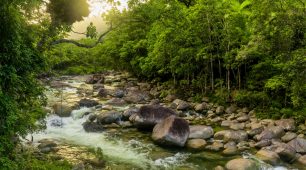
Near still ponds and slow rainforest streams after dark. By day they roost high in the leaves.
When is the best time?
After heavy rain in spring and summer, when the males call with a deep, barking chorus.
How big do they get?
11 to 14 cm, making them Australia’s largest tree frog. Females are usually bigger than males.
White-lipped Green Tree Frog the Ultimate Guide


White-lipped Green Tree Frog
- Largest tree frog in Australia and the world, reaching 11–14 cm in length (females typically larger).
- Named for its distinctive white stripe along the lower lip extending to the shoulder; some hind‑leg stripes may turn salmon‑pink in breeding males.
- Colour varies from emerald green to brown depending on environment, temperature, and mood for camouflage.
- Arboreal and nocturnal, often found close to still ponds or rainforest streams, hunting insects after dark and roosting high in foliage by day.
- Males produce a deep, barking chorus after wet season rains (especially spring–summer) to attract mates—this nightly concert is a hallmark of rainforest evenings.
- Females lay up to 100 eggs in floating jelly clumps on still water; tadpoles drop into the water below and metamorphose into froglets in about 6–8 weeks.
- Plays a key role as an insect predator, helping control mosquito and pest populations—essential for ecosystem balance.
About the White-lipped Green Tree Frog
Discover the charming White‑lipped Green Tree Frog (Litoria infrafrenata)—an unforgettable resident of the Daintree Rainforest, and a highlight for nature lovers visiting Far North Queensland.
Habitat and Ecology in the Daintree
- Found throughout the Wet Tropics and coastal lowlands of northeast Queensland, including the Daintree area—below 1,200 m altitude.
- Adaptable across habitats: tropical rainforest, mangroves, sclerophyll forest, even suburban gardens and cultivated areas near water.
- Not threatened—listed as Least Concern by the IUCN, with a broad distribution and stable populations. However, habitat loss and chytrid fungus remain local risks.
Spotting Tips in the Daintree
- Best seen after heavy rains in spring and summer when males call and assemble near ponds or slow rainforest streams.
- Join a guided night tour or river cruise to catch their nocturnal activity.
- Listen closely for the barking chorus echoing through the rainforest. Some individuals may be visible on foliage above water.
FAQs
Are White-lipped Green Tree Frogs dangerous or venomous?
Can I spot them during the day?
How long do they live?
When is breeding season in the Daintree?
How important are they to the ecosystem?
Final Thoughts
The White-lipped Green Tree Frog is a nightly performer in the Daintree Rainforest—its vibrant green hue, melodic calls, and ecological importance make it one of the rainforest’s most enchanting citizens. Observing it under moonlit canopies is a magical highlight of any Daintree visit.
Travel Kindly
At Hot Getaways, care is our compass — and a little kindness makes every journey better. When you visit the Daintree, we gently ask you to:
- Tread lightly in the rainforest — stay on the boardwalks and marked tracks to protect this ancient, fragile ecosystem.
- Respect the wildlife — never feed cassowaries or any animals, keep your distance, and take your rubbish home with you.
- Support local — choosing local operators, cafés and guides helps this beautiful place thrive.
- Honour Country — we travel on the traditional lands and sea Country of Australia’s First Peoples, with gratitude and respect to the Traditional Custodians past and present.
- Be kind to each other — a smile, a little patience and a helping hand make the day lovelier for everyone.
Small acts of care add up to something wonderful. Thank you for travelling kindly.