

Quick Answers
What makes Victoria’s riflebird special?
It is one of Australia’s birds-of-paradise. Males have iridescent plumage and a side-to-side wing display.
When is the best time to see one?
The breeding season, June to February, when males are displaying.
Is Victoria’s riflebird endangered?
It is listed as Vulnerable.
Victorias Riflebird The Ultimate Guide


Victoria’s Riflebird – Quick Facts
- Endemic to Queensland’s Wet Tropics, including the Daintree Rainforest and Atherton Tablelands—found nowhere else on Earth.
- The smallest riflebird species, measuring about 23–25 cm long and weighing just over 100 g.
- Males boast velvet-black plumage with an iridescent green-blue throat patch and purple to blue-green sheen on the head and neck.
- Famous for elaborate courtship displays during the breeding season (June–February), where males raise wings, tilt heads, and sway side to side in dappled light.
- Diet includes insects and fruit, making them important pollinators and seed dispersers in the rainforest.
- Known for their distinctive raspy “yaars” call, often heard before they are seen in the canopy.
- Listed as Vulnerable due to habitat loss and fragmentation—highlighting the importance of rainforest conservation.
Discover Victoria’s Riflebird
Welcome to VisitDaintree.com — your portal to the wonders of Australia’s oldest rainforest. Discover the breathtaking Victoria’s Riflebird (Ptiloris victoriae), a dazzling member of the bird-of-paradise family that graces Daintree’s canopy with remarkable displays of colour and courtship.
Meet Victoria’s Riflebird
-
Victoria’s Riflebird is a bird-of-paradise endemic to northeastern Queensland, mainly the Atherton Tablelands and the Daintree Rainforest, where it lives year-round
-
It’s the smallest riflebird, measuring around 23–25 cm in length and weighing approximately 105–120 g.
Iridescent Courtship and Male Displays
- The male’s velvet-black body is accented with an iridescent purple to blue-green sheen on the head, and a metallic green-blue triangular patch on his throat.
- During breeding (June–February), males engage in elaborate solo displays: erecting throat and side feathers in shafts of light, curving wings over the body, tilting the head back, and moving side to side in mechanical rhythm to attract females.
- Males also call with a distinctive raspy “yaars”, softening into melodic tones as their display continues.
Habitat and Why It Matters
- Though endemic to the Atherton Tablelands, Victoria’s Riflebird thrives in Daintree’s lowland and hill rainforest zones, forming part of the Daintree Important Bird Area.
- It inhabits dense canopies and thick undergrowth, sometimes extending into adjacent wet sclerophyll forests and mangrove edges.
- These birds contribute to rainforest health by pollinating flowers and dispersing seeds, particularly through fruit feeding during breeding seasons.
Diet and Foraging Habits
-
Victoria’s Riflebird is primarily insectivorous, foraging by climbing trunks and branches and probing under bark for insects and larvae using its slender decurved bill.
-
It also eats fruits, sometimes peeling them with its bill while holding them with a foot—with males favouring fruit and females shifting more to insects when feeding young.
Spotting One in the Daintree
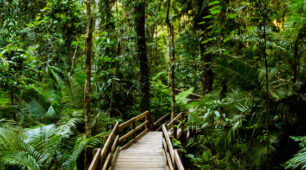
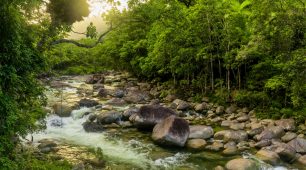
- Guided birdwatching tours through the Daintree Rainforest, especially around Mossman Gorge and higher-altitude boardwalks, offer opportunities to spot this elusive bird.
- Visit during breeding season (June–February) for a chance to witness the male’s display amid dappled sunlight breaking the rainforest floor.
- Listen for the distinctive “yaars” call, and look for the male perched on vertical tree ferns or broken stumps in open canopy.
FAQs Victoria’s Riflebird
What makes Victoria’s Riflebird unique?
Is Victoria’s Riflebird endangered?
When is best to see them?
What kind of habitat do they prefer in the Daintree?
How can visitors improve chances of spotting one?
Final Thoughts
The Victoria’s Riflebird is more than a bird—it’s a living performance in the rainforest, blending elegance, mystery, and ecological importance. At VisitDaintree.com, we aim to connect you with these magical moments in one of Australia’s richest natural landscapes. Let’s help you plan your visit and maybe witness the glory of a courting riflebird in the rainforest spotlight.
Discover the Daintree Rainforest
Travel Kindly
At Hot Getaways, care is our compass — and a little kindness makes every journey better. When you visit the Daintree, we gently ask you to:
- Tread lightly in the rainforest — stay on the boardwalks and marked tracks to protect this ancient, fragile ecosystem.
- Respect the wildlife — never feed cassowaries or any animals, keep your distance, and take your rubbish home with you.
- Support local — choosing local operators, cafés and guides helps this beautiful place thrive.
- Honour Country — we travel on the traditional lands and sea Country of Australia’s First Peoples, with gratitude and respect to the Traditional Custodians past and present.
- Be kind to each other — a smile, a little patience and a helping hand make the day lovelier for everyone.
Small acts of care add up to something wonderful. Thank you for travelling kindly.